Bite Through the Idol: On the Raw Mouth, the Beloved, and What Cannot Die
What if nobody dies?
Not the way we think. Not the way fear tells it. What if the thing that trembles — that rabbit — never had continuity to begin with? And the thing that watches the trembling was never born?
This is perhaps the oldest news in the world, and still the hardest to swallow.
1. The Rabbit
Start with the image. A rabbit — raw, uncooked — held in the mouth. Blood on the tongue. Teeth meeting through flesh and bone.
The rabbit is the prey animal. It is the creature that lives inside fear. Its entire nervous system is organized around one signal: something is coming to kill me. The rabbit freezes, the rabbit bolts, the rabbit trembles even in sleep. In mythology, the rabbit belongs to the moon — to cycles, to fertility, to illusion. The Aztecs placed the rabbit inside the moon itself. In the Buddhist Jataka tales, a rabbit throws itself into fire as the ultimate sacrifice — offering its own body because it has nothing else to give. And across African, Native American, and European folklore, the rabbit is the trickster — the one who survives by cunning what it cannot defeat by force.
So what is in your mouth, when the rabbit is in your mouth?
Fear. Illusion. Fertility. Sacrifice. Cunning. The whole machinery of the prey-self — the part of you that has organized your entire life around not being devoured.
And you are devouring it.
Raw. No cooking. No fire. No civilization mediating the act. Lévi-Strauss built an entire anthropology around this distinction: the raw is nature, the cooked is culture. To eat something raw is to refuse the processing, the softening, the making-palatable that civilization demands. This is the Dionysian act. The Maenads — those ecstatic, god-drunk women who followed Dionysus — practiced omophagia, the ritual eating of raw flesh. They tore animals apart with bare hands and consumed them. This was not savagery. This was becoming the god. Taking the wild divine directly into the body without the filter of reason or ritual propriety.
Apollo cooks. Dionysus devours.
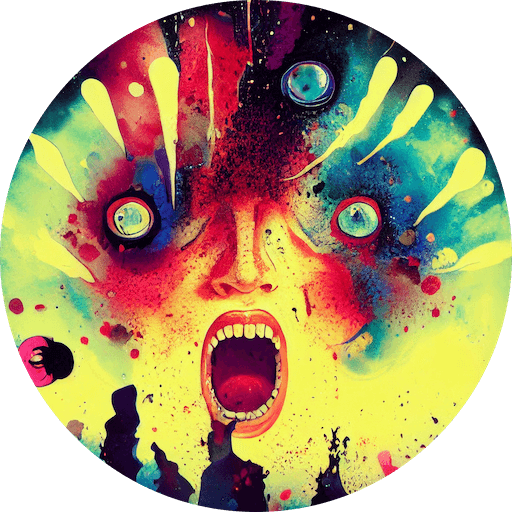
And the blood — the blood in the mouth — is life-force flooding the place where language lives. The mouth is where logos comes from. Speech, the word, the concept, the explanation. Blood in the mouth is something pre-verbal overwhelming the verbal. Something alive drowning the part of you that narrates your life into submission.
2. Biting Through
Hexagram 21. Shih Ho. Biting Through.
The I Ching gives us a picture of a mouth with something lodged between the teeth. The jaws cannot close. There is an obstruction, and the only resolution is to bite through it — decisively, with force. Fire over thunder. Clarity above, arousal below. You see the obstruction and you act on it without hesitation.
Most hexagrams counsel patience. Yielding. Waiting. This one says: bite down now.
What if the obstruction is not external? What if the thing between the teeth — the thing that must be bitten through — is the rabbit itself?
The fear. The trembling. The prey-consciousness. The lunar illusion. You cannot gently process this. You cannot cook it into a concept or meditate it into transparency. You have to crack it with your jaws.
And the blood that results is not cruelty. It is justice. There is a difference the civilized mind keeps refusing to acknowledge. The blood is what happens when an obstruction is actually removed rather than managed or spiritualized away.
The jaws close. The circuit completes. Something that was stuck is no longer stuck.
3. Sanam
Now — the beloved.
Sanam (صنم) — from Arabic. It means idol. A stone figure worshipped in pre-Islamic Arabia. A form through which the divine could be accessed. Before the iconoclasts came and smashed the idols, the sanam was the body of God made touchable, visible, present.
In Persian and Urdu it became the word for beloved. Sweetheart. Darling. The one you worship. The beloved and the idol — the same word. The one you love and the one you bow before, collapsed into a single sound. Sufi poetry runs on this voltage. Rumi and Hafiz play this edge constantly: I worship the sanam. Is that blasphemy or the highest devotion? In the tradition, the answer is: both. That is the point.
In Sanskrit, sanam means something else entirely — “of old, formerly.” An adverb of time pointing backward. What was. The ancient. The prior.
In Latin, sanam derives from sanus — sound, whole, healthy, sane. Unbroken.
Hold these together:
Four unrelated languages. Four unrelated roots. And yet — idol, beloved, ancient, whole. As if the sound itself remembers something the etymologies forgot.
4 The Idol Must Be Eaten
Here is where everything converges.
The sanam sits on an altar. You approach it, you bow, you leave offerings, you sing to it, you write poems about it. You maintain the gap. That is how religion works. That is how most spirituality works. That is how most people relate to what they say they love. There is always a distance. Always the fire of cooking between you and the raw thing.
The raw rabbit in the mouth is what happens when someone closes the gap.
You have taken the idol off the altar and bitten into it. You are not worshipping it. You are not contemplating it. You are consuming it. And it is not sanitized, not prepared, not made acceptable. It is raw and there is blood, which means there is life still in it, which means this is not a dead symbol — this is a living encounter that has not been processed into something manageable.
What if the rabbit is the sanam? What if the thing you have been worshipping from a distance — the beloved, the idol, the face of God — turns out to be your own fear? Your own fertility? Your own illusion? The trickster in your own chest?
And the only way to actually have it — not admire it, not perform devotion to it — is to bite through.
5. What Cannot Die
The Atman — the Self in Vedantic teaching — is described as ajaat, ajanma, amar. Never born, never died. It does not enter the body. It does not leave the body. It is not affected by what happens to the body. It is not improved by spiritual practice. It is not damaged by ignorance. It is the witness — sakshi — that illuminates all experience while remaining untouched by any of it.
The Bhagavad Gita: It neither slays, nor can it be slain. It is nitya — always. Sasvatah — permanent. Purana — very ancient. It is unborn, eternal, ever-existing.
What if this is not a belief but a diagnosis? Not something to accept on faith — but something to check against your own experience of what persists when everything else is stripped away.
What most people call “I” is not the Atman. What most people call “I” is the jivātman — the ego, the “I-sense” — which Vedanta identifies not with the Self but with prakriti, with nature itself. Prakriti keeps waving like an ocean. Every wave rising is a birth. Every wave falling is a death. The ocean neither rises nor falls.
The ego — the ahamkara, the “I-maker” — has no continuity. Not in the way it believes. Memory provides the illusion. You wake up and feel like the same person because memory stitches yesterday to today. But the Vedantic insight cuts deeper: the ego is not a thing that persists. It is a process that keeps re-creating itself moment to moment, grasping at each new identification the way fire grasps at fuel. I am this body. I am this thought. I am this story. I am this fear.
None of that is you.
What you are is the awareness in which all of that appears and disappears. Not the content. Not the weather. The sky. The sky is not troubled by storms. It does not celebrate clear days. It holds both without preference, without memory, without effort.
6. The Three Bodies
Between the Atman and the physical flesh, there are layers. Vedanta maps three — sharira traya — and each one matters for understanding what actually happens at death, and where the real work is.
Sthula Sharira — the gross body. Meat, bone, blood. One lifetime only. When it burns, its elements return to elements. This is the rabbit’s body. The prey-flesh. The thing that can be killed.
Sukshma Sharira — the subtle body. Mind, prana, intellect, ahamkara. Carries the samskaras across lives — but not the “I.” The pattern transmigrates; the ego dissolves and re-forms fresh each birth. The wave is new. The water is old. This is also where the nadis live, the chakras, the coiled kundalini. Where the blood of the bitten-through rabbit lands.
Karana Sharira — the causal body. The seed. Beginningless ignorance. The unmanifest potential of the other two — the way a forest already exists inside an acorn. Experienced in deep dreamless sleep, where the ego dissolves and there is only rest without a rester.
The Atman is beyond all three. It wears these bodies the way you wear clothes. Take off the gross body — that is death. Take off the subtle body — that is liberation. Take off the causal body — and what remains is Brahman. What was always Brahman.
Now — Gurdjieff mapped something parallel from a completely different direction. He spoke of four possible bodies, composed of increasingly rarefied matter. The physical body is mechanical, automatic, subject to all the laws of the material world. But the astral body — and here is the crucial, uncomfortable difference — Gurdjieff said a person is not born with one. An ordinary person does not possess an astral body. It must be built through sustained conscious effort. Only then can it maintain self-consciousness. Only then does it survive the death of the physical body.
Beyond that, he described a mental body and a fourth body, each corresponding to higher levels of the cosmos, each subject to fewer laws, each more free.
Where Vedanta and Gurdjieff converge is here: what you ordinarily call “yourself” is mechanical. It has no real continuity. It is reactions, identifications, conditioned responses creating the illusion of a person. The ego does not persist — it re-creates itself each moment, and calls that persistence.
What actually persists is either the Atman — which was never threatened — or, in Gurdjieff’s more demanding formulation, a higher body that must be earned through work.
Perhaps these are not contradictory. Perhaps Vedanta is describing the ground — what is always already the case. And Gurdjieff is describing the practical problem — that knowing the ground changes nothing if you have not built a vehicle that can stay there.
7. Accessing the Higher Intelligence
So if the ego has no continuity and the Atman cannot die — what is the work?
The work is in the middle. In the subtle body. In the astral layer. In what Gurdjieff called the higher centers.
He described two that remain dormant in nearly all human beings: the higher emotional center and the higher intellectual center. These are not refined versions of ordinary feeling and ordinary thinking.
They are entirely different organs, operating with different substances, at vastly different speeds. And — this is the part that matters — they are already functioning. Already transmitting. The problem is not that they are absent.
The problem is that ordinary consciousness is too noisy, too identified, too consumed by what Gurdjieff called mechanical imagination — the endless internal cinema of daydreaming, rehearsing, replaying — to receive what they are broadcasting.
The signal is always there. The receiver is jammed.
His term for the practice that unjams the receiver is self-remembering — divided attention in which you are aware simultaneously of what you experience and the one experiencing it. Not lost in the object. Not collapsed into reaction. Present to both the seen and the seer, at once. This produces a different quality of presence. It generates what his system calls finer hydrogens — substances refined enough to make contact with higher centers.
Yogananda described the same territory from the yogic side. The ascent of consciousness through the subtle centers of the spine. The awakening of the spiritual eye. The perception of astral forces that govern creation. In his language, supreme consciousness is not something foreign that enters you from outside. It is already present — bottled up in flesh, sealed with ignorance, floating in an infinite ocean it cannot touch.
Jeanne de Salzmann, Gurdjieff’s most trusted student, put it simply: The higher energy is the permanent Self, but you have no connection with that. For that connection, a fine substance needs to be generated. Otherwise, the energy of the body is too low to make contact with the very high energy which comes from above.
The energy of the body is too low. Not the energy of the Atman — that is boundless. The energy of your ordinary state. The state in which you scroll, react, identify, narrate, judge, defend, perform. That frequency cannot receive what is above it. Not because it is forbidden, but because the instrument has not been tuned.
8. The Healing
So what is the healing?
Not fixing the ego. The ego cannot be fixed because it was never whole. It is a process, not a thing. You cannot repair a wave.
Not killing the ego either. Pause here, because this is where most seekers get trapped. The desire to destroy the ego is itself the ego’s most sophisticated production — the “I” that wants to annihilate the “I,” which is just the “I” wearing a spiritual costume. It is the prey animal pretending to be the predator. Still the same rabbit, still running.
The healing is something else. The healing is biting through.
It is the act of closing the distance between the worshipper and the idol. Between the fearful self and the thing it fears. Between the mouth and the raw, bloody, living truth that has been sitting on the altar — beautiful, untouchable, worshipped from a distance — while you starved.
The rabbit is your fear. The idol is your beloved. They are the same creature. And the obstruction in Hexagram 21 — the thing lodged between the jaws that will not let them close — is the distance you have maintained between yourself and your own nature. The reverence that became avoidance. The worship that became delay. The study that became a substitute for contact.
Bite through.
Not conceptually. Not by reading one more book or having one more insight. The Gita says the Atman cannot be cut by weapons, burned by fire, wetted by water, or dried by wind. It is permanent, all-pervading, stable, immovable, eternal. You cannot damage what you are. You can only stop pretending you are something else.
The subtle body is where the work lands. It is where the samskaras live, where the karma is stored, where the nadis carry prana, where the chakras serve as junction points, where kundalini sleeps coiled at the base. Not the gross body, which is just meat and will return to its elements regardless. Not the Atman, which needs no transformation and never did. The middle ground. The place where the ego’s mechanical repetitions can be interrupted by a conscious shock that opens a channel upward.
Gurdjieff called it self-remembering. Vedanta calls it viveka — discrimination between the real and the unreal. Yogananda called it the ascent through the spine. The Sufis call it fana — the annihilation of the false self in preparation for union with what is real. Hexagram 21 calls it biting through.
Different names. One act: the moment you stop worshipping the beloved from a distance and begin to live as it.
The blood in the mouth is the proof that it happened. Not a concept but a contact. The idol consumed. The jaws closed. The circuit complete.
And what remains — after the obstruction is bitten through, after the idol is eaten, after the ego sees it was never continuous, after the Atman is recognized as never having been absent — is sanam in its deepest convergence.
Wholeness. Sanus. Sound. Unbroken.
Not holy. Not enlightened. Not special.
What was always there, before the altar was built.
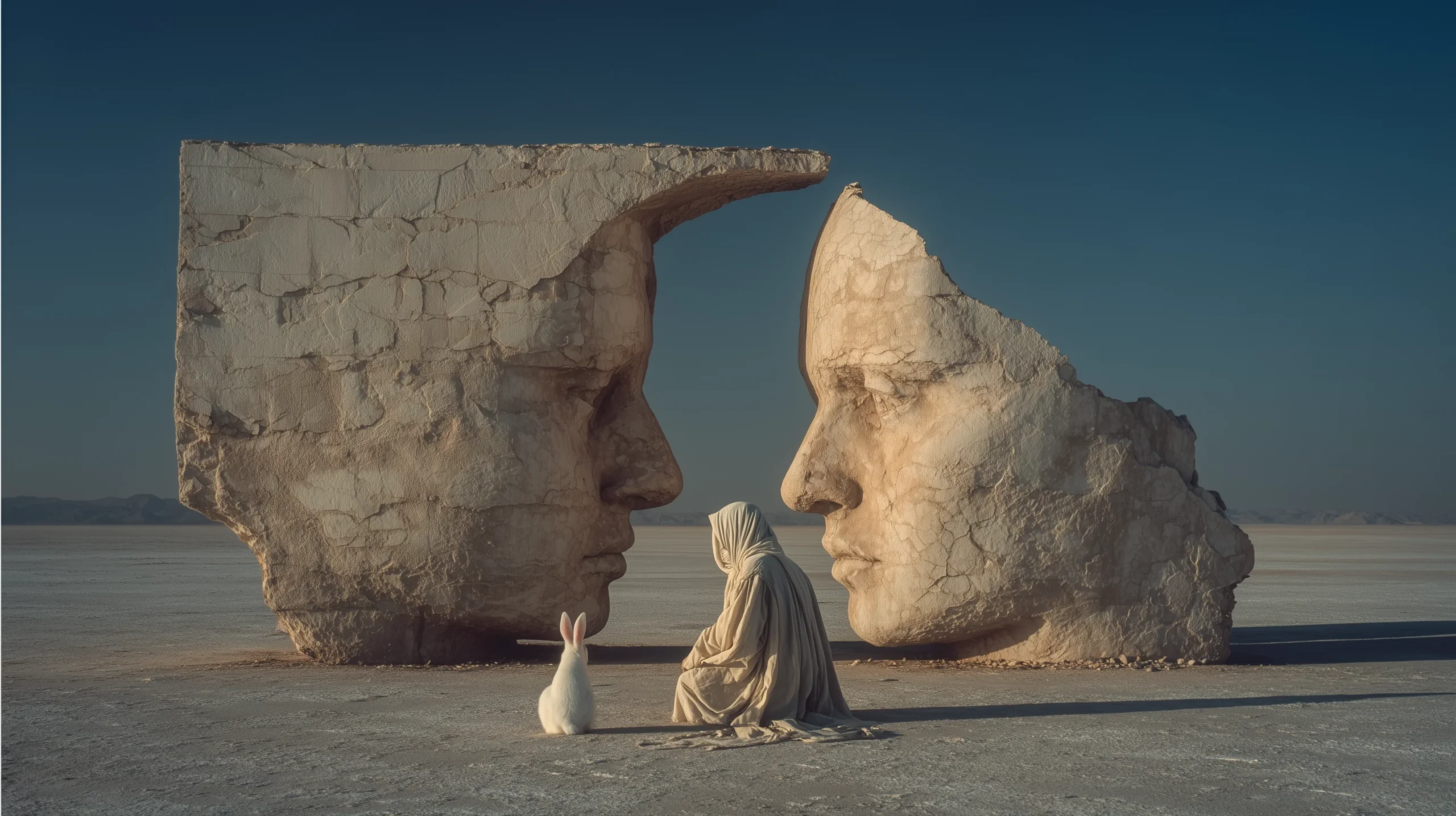
And if the wholeness was there before the altar — then any altar works. And no altar is necessary. Shiva, Christ, Buddha, the rabbit, a stone in the desert — the form was never the point. The biting through was the point. Once the jaws close, the name dissolves. What remains has no name. But on the way there — call it whatever gets your teeth into it.
And perhaps biting through is the wrong emphasis. Perhaps it is not force at all. Perhaps the jaws close only when you stop holding them open. When you stop maintaining the distance. When you accept what was always in your mouth. Surrender the ego. Humble yourself enough to stop performing the seeker and simply be what was never lost.
The bite is not aggression. It is acceptance with teeth.
Then justice will be done.
The idol must be eaten to end the worship, and what remains is not the worshipper or the worshipped but the wholeness that was there before the distance was invented.