The Tulip In The Abyss
Glitch cinema presents,
THE TULIP IN THE ABYSS
There is a place beneath the place you call rock bottom. Beneath the worst thing that ever happened to you. Beneath the moment you said this is it, I cannot fall further. There is a place beneath that. And beneath that. And beneath that. The falling does not stop where you think it stops. The falling is deeper than your fear of falling.
I have been there. You have been there. Everyone who has ever lived long enough to lose something they thought they could not lose — they have been there. The address is not on any map. But the body knows the way.
Let me tell you about the abyss.
It is not dramatic. That is the first lie they told you. They showed you paintings of fire and demons and gnashing teeth, as if the worst place a human can go would announce itself with spectacle. It does not. The abyss is quiet. The abyss is ordinary. The abyss is a Tuesday afternoon when the phone doesn’t ring and you realize no one is coming. Not today. Not tomorrow. Not ever.
The abyss is the moment after the doctor speaks and before you can respond. The moment when the words are still traveling from your ears to your understanding, and somewhere in that distance, the life you thought you were living dies. The new life — the one you did not choose, the one that was chosen for you — has not yet begun to breathe.
I knew a woman who lived in the abyss for seven years.
Her child died. I will not tell you how. The how does not matter. Every parent who loses a child loses the same child — the future. The first word and the last word and every word in between that will never be spoken. The wedding that will not happen. The grandchildren who will not exist. The ordinary Tuesday afternoons that will never bore her with their beautiful ordinary demands.
The child died. The woman did not.
This is the cruelty no one tells you about: the body keeps breathing. The heart keeps beating. The lungs keep filling and emptying, filling and emptying, as if nothing has happened, as if the world has not just ended, as if there is still a reason to take in air and push it out again.
She wanted to stop. She begged her body to stop. But the body has its own orders. The body answers to something older than grief.
For seven years, she lived in the abyss. Not dramatically. Not poetically. She woke up. She dressed herself. She bought groceries and paid bills and answered when people asked how she was doing. Fine, she said. I’m fine. The word became a locked door. Behind it, the abyss.
She did not believe in God. She had believed once — before. Before was a country she could no longer visit. Before was a language she had forgotten how to speak. After did not believe in anything. After was just endurance. One breath, then another. One hour, then another. One year, then another.
Seven years.
And then.
She was walking. Not for any reason. The body needed to move, so she let it move. A street she had walked a hundred times. A garden she had passed without seeing. But this time — this ordinary, unremarkable time — she stopped.
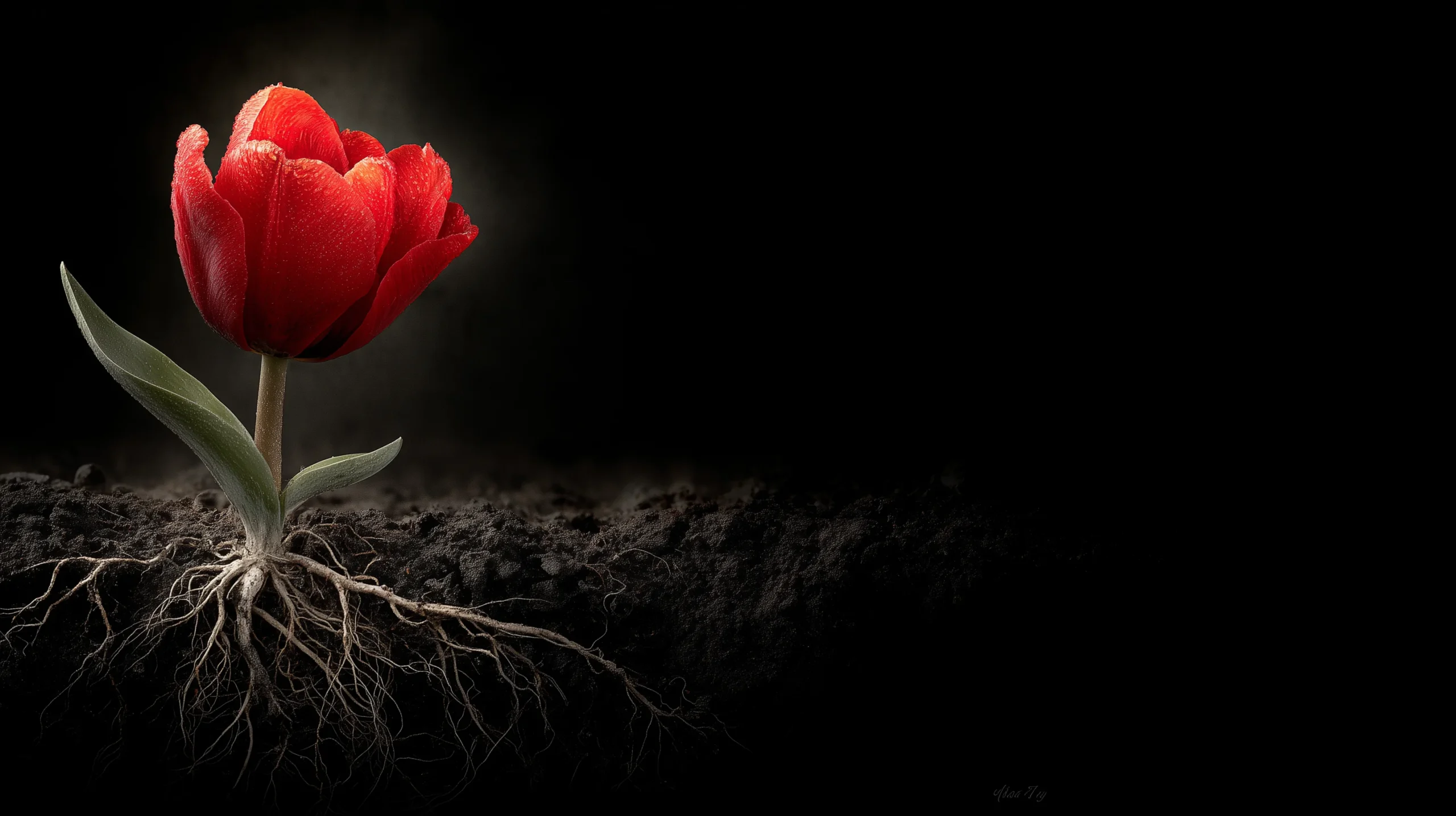
A tulip. One tulip. Red. Not special. Not rare. The kind of tulip that grows in a thousand gardens in a thousand cities, the kind that appears every spring as if spring were a promise that could be trusted.
She stood there. Looking at a flower. And something inside her — something that had been locked for seven years — cracked open.
Not because the tulip was beautiful. It was, but beauty had not reached her in seven years. Not because the tulip reminded her of her child. It did not. The child had no special connection to tulips, to red, to gardens, to spring.
Something else.
Something about the way the tulip was just there. Ordinary. Unbothered. A flower doing what flowers do — growing toward the light without asking why, blooming without needing permission, existing without apology.
The tulip did not know about her grief. The tulip did not care about her loss. The tulip was not trying to teach her anything, prove anything, fix anything.
The tulip was just being a tulip.
And in that simple being — that ordinary ordinary ordinary being — she saw something she had not seen in seven years.
Let me tell you about the tulip.
Before it is a tulip, it is a bulb. A small, ugly thing. Brown and papery and insignificant. You would step on it without noticing. You would throw it away if you found it in your kitchen drawer.
The bulb is buried. This is important. Not planted — buried. Pushed into the dark earth and covered over. Left there. Forgotten. The gardener walks away. The winter comes. The ground freezes. Snow falls and covers the place where the bulb is not-being.
For months, nothing. No sign of life. No proof that anything was ever planted. Just cold earth and white silence and the long wait of winter.
If the bulb could think — if the bulb could feel — what would it feel? Buried. Forgotten. Surrounded by darkness, by cold, by the crushing weight of frozen earth. No light. No warmth. No evidence that anything exists beyond this tomb of soil.
If the bulb had faith, it would lose it here. If the bulb had hope, the hope would die here. There is nothing in the abyss to sustain faith or hope. That is what makes it the abyss.
But the bulb does not need faith. The bulb does not need hope. The bulb has something else. Something older. Something that does not require belief.
The bulb has pattern. The bulb has code. Written into every cell, a set of instructions so ancient they predate language, predate thought, predate the first human who ever looked up at the sky and asked why.
The instructions say: wait.
The instructions say: when the time comes, you will know.
The instructions say: the light is not gone, it is only hidden, and you are not forgotten, you are only held.
The woman stood in front of the tulip and wept.
Not grief this time. Something else. Something that does not have a name in the language they taught her.
The tulip did not survive the winter. Survival is a human word, a human fear. The tulip did not endure the darkness. Endurance is what you do when you are fighting something.
The tulip became the darkness. The tulip let the darkness have it completely. The bulb did not resist the cold, did not resent the burial, did not rail against the months of nothing. The bulb simply was — in the dark, in the cold, in the place where nothing seemed to be happening.
And all the while, invisibly, impossibly, something was happening. Roots were reaching downward. Energy was gathering. The code was executing, line by line, in the silence beneath the silence.
The tulip trusted something the woman had forgotten how to trust.
Divine Will.
The words feel strange in the mouth. Old-fashioned. Suspect. Too close to the men who used them to justify cruelty, too tangled with the religions that disappointed, too heavy with the prayers that were not answered.
But there is something beneath the words. Beneath the theology. Beneath the arguments for and against. Something the tulip knows. Something the bulb knows. Something the body knows — your body, which kept breathing when you begged it to stop, which kept your heart beating through the worst night of your life, which carried you through seven years of abyss without asking for your permission or your faith.
Divine Will is not a man in the sky deciding your fate. That is the children’s version, and it breaks as soon as life gets heavy. Divine Will is not a plan that makes sense, a story with a moral, a test you pass or fail. That is the version they sell to people who have not yet been to the abyss.
Divine Will is the pattern beneath the pattern. The code that executes in the dark. The instructions written into the bulb, into the seed, into the cell, into the atom, into the very fabric of what is.
It does not ask for your belief. It does not require your faith. It operates whether you trust it or not, whether you see it or not, whether you curse it or praise it or ignore it completely.
It is the reason the spring comes after the winter. Not because spring is a reward for surviving. Because spring is what winter becomes. Because the cold is not the enemy of the bloom — the cold is the condition for the bloom. Because the abyss is not the opposite of the light — the abyss is where the light learns its own name.
She stood there, the woman, looking at a tulip.
And for the first time in seven years, she felt something other than grief. Not happiness. Happiness is too small a word for what she felt. Not peace. Peace is what you feel when the war is over. This was not over. This would never be over. Her child was still dead. The abyss was still real. She would return to it — not today, but someday, she would visit that darkness again.
What she felt was — security.
Not safety. Safety is the absence of danger, and danger is everywhere, always. Her child had taught her that. Safety is a lie we tell ourselves until the truth arrives.
Security is different. Security is not the absence of danger. Security is the presence of something that holds you even in danger. Security is the bulb in the frozen ground, not knowing spring will come, not needing to know, because the pattern holds. The code executes. The light returns — not because you earned it, not because you believed hard enough, but because returning is what light does.
The tulip did not save her. That is not how this works. There is no savior coming, no rescue at the last moment, no hand reaching down from the sky to pull you out of the abyss. That is the version they tell people who have not yet been buried.
The tulip showed her something. The tulip was evidence. Not proof — proof is for mathematics. Evidence. A single data point in an overwhelming darkness. A red flower in a ordinary garden saying, without words, without intention, without any awareness of its own holiness:
The pattern holds.
The code executes.
The winter is not forever.
The burial is not punishment.
The abyss is not where you go to be forgotten.
The abyss is where you go to be planted.
She began to walk again. Not healed. Healing is not the goal. The wound of her child would never heal — she did not want it to heal. The wound was where her child still lived, still touched her, still mattered.
But she walked differently now. Lighter. Not because the weight was gone. Because she was no longer carrying it alone.
Something else was carrying it with her. Something that did not need her to name it, define it, believe in it. Something that had been carrying it all along — through seven years of abyss, through every breath she did not want to take, through every morning she did not want to see.
She had not been abandoned in the dark.
She had been planted.
This is the secret they could not teach you in churches or temples or mosques. Not because they did not try. Because some things cannot be taught. Some things can only be shown. Some things can only be seen by eyes that have wept themselves empty.
God — if you want to use that word — is not the one who prevents the abyss. God is the one who meets you there. Not with rescue. Not with explanation. Not with the answer to why.
With presence. Just presence. The way the soil is present to the bulb. The way the winter is present to the spring it is becoming. The way the darkness is present to the light it is teaching to see.
Security is not knowing what will happen. Security is not being safe from pain. Security is discovering — in the deepest deep, in the darkest dark, in the place where hope cannot survive — that something else can.
Not hope. Hope needs a future, and in the abyss there is no future.
Not faith. Faith needs belief, and in the abyss belief is a luxury you cannot afford.
Something older. Something beneath hope and faith. Something the bulb knows, the seed knows, the body knows.
The pattern holds.
That is all. That is everything.
The pattern holds.
The woman went home that day and sat by her window. She did not pray. She did not meditate. She did not do anything that could be taught or prescribed or turned into a method.
She just sat. The way the bulb sits in the frozen earth. The way the abyss sits beneath the surface of every ordinary day. She let herself be held by something she could not name. She let the pattern have her.
And somewhere — in a part of her she had thought was dead — something began to stir. Not the old life. That was gone and would not return. Something new. Something that could only grow in the soil of what she had lost.
A green shoot. Pushing up through the dark.
Not yet a flower.
But alive.
You who are reading this.
You who are in the abyss now, or have been, or will be. You who have lost the thing you thought you could not lose. You who have stopped believing in the stories they told you about how things work, about why things happen, about what waits on the other side of suffering.
I am not here to give you hope. Hope is too small for what you need.
I am here to show you a tulip.
One red flower in an ordinary garden. A bulb that was buried, forgotten, frozen, left for dead. A pattern that executed in the silence, without witness, without faith, without any evidence that spring would ever come.
And then spring came. Not because the bulb believed. Because spring is what winter becomes.
You are the bulb. You have always been the bulb.
The abyss is not your enemy. The abyss is your soil. The grief is not your punishment. The grief is your planting. The winter is not your ending. The winter is your becoming.
You do not need to believe this. The tulip did not believe in spring. The tulip just grew toward something it could not see, following instructions it did not write, trusting a pattern it could not understand.
That is all you have to do.
Not believe. Not hope. Not endure.
Just grow. In the direction you are already growing. Toward the light you cannot yet see.
The pattern holds. The pattern holds. The pattern holds.
She is old now, the woman. The child has been dead longer than the child was alive. The abyss is a country she visits sometimes — not to live there, but to remember what she learned when she had no choice but to learn it.
She keeps tulips in her garden. Not as memorial. Not as symbol. As evidence. As witnesses. As ordinary proof that the winter is not the end of the story.
Every spring, they return. She did nothing to deserve their return. She cannot explain why they return. She only knows that they do — red and yellow and purple, pushing through the earth that held them all winter, reaching for a sun they could not see until they could.
Divine Will, she calls it now. Not because she believes in a god who plans and judges and rewards. Because she has no other words for the pattern that holds, the code that executes, the spring that comes after every winter she has ever survived.
One day she will die. The tulips will keep coming. The abyss will keep taking people she never met. The pattern will keep holding, long after she is gone, long after you are gone, long after the last human who remembers what hope felt like has turned to dust and been forgotten.
This is not sad. This is security. This is the ground beneath the ground. This is the one thing that cannot be lost because it was never yours to keep.
The pattern holds.
You are held.
You have always been held.
Even now. Especially now. In the abyss you thought was punishment, in the winter you thought would never end, in the burial you mistook for death.
You are not dying.
You are being planted.
Grow toward what you cannot see.
Trust the code you did not write.
Let the winter have you completely.
And when the spring comes — not because you earned it, not because you believed, but because spring is what winter becomes —
Bloom.
Not for anyone.
Not to prove anything.
Just bloom.
The way the tulip blooms.
Ordinary. Holy. Red against the morning.
Evidence that the pattern holds.
She saw it in a tulip. He found it in the dust. Another in a stranger’s eyes, another in the rust.
Neti neti — not this, not this — and yet, and yet, and yet: this too. And this. And this.
The nameless wears a thousand masks and answers to them all. You cannot find it seeking. You cannot miss it when you fall.
END TRANSMISSION