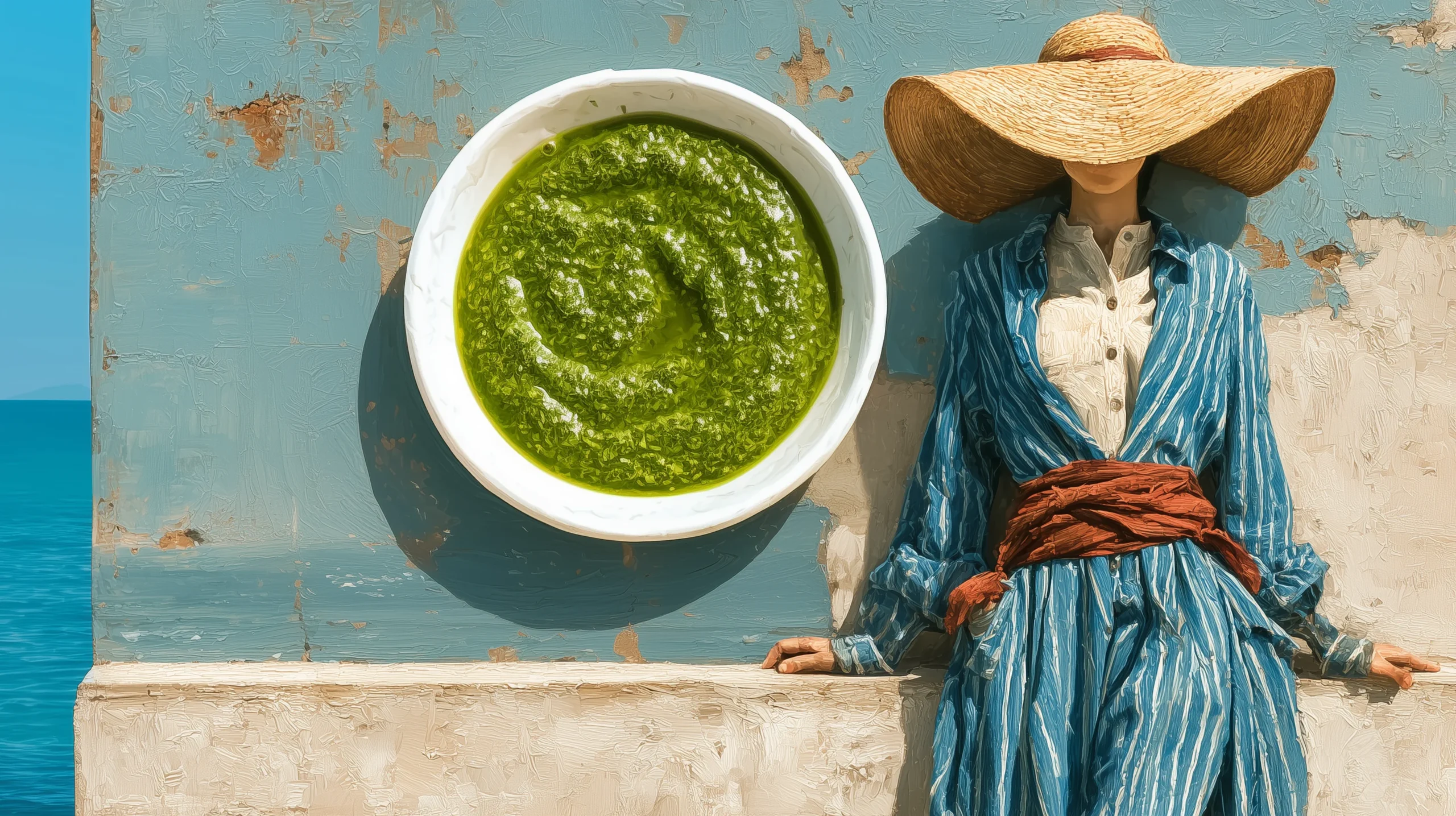
The Pesto Doesn’t Know Yet
Glitch cinema presents,
THE PESTO DOESN’T KNOW YET
The day your life falls apart, someone will offer you cake. This is not a metaphor. This is Tuesday. You will be standing in the ruins of everything you thought you were building, and a woman you have never met will hold out a paper plate with a slice of strawberry cake and say: they had extra at the office.
You will eat the cake. It will be too sweet. The frosting will be the wrong color — that aggressive pink that exists nowhere in nature. You will eat it anyway because your hands need something to do and your mouth has forgotten how to say what just happened.
Let me tell you what just happened.
You lost the job. Or the job lost you — it’s hard to tell who left whom when the security guard is watching you pack your desk into a cardboard box. Eleven years. Four thousand days of showing up. You learned to make the coffee the way the boss liked it. You learned which elevator was faster. You learned to laugh at jokes that weren’t funny because laughing was easier than not laughing.
Eleven years. One box. The math refuses to cooperate. Eleven years should equal more than one box. Eleven years should be heavier than this.
The apartment is the same as you left it. This feels like a betrayal. Something this big should change the furniture, should tilt the pictures on the wall, should leave evidence. But the coffee cup is still in the sink. The bed is still unmade.
The pesto you made last week is still in the fridge. Waiting for pasta that will never come because you made pesto when you were someone with a job and now you are someone without one.
The pesto doesn’t know yet. The pesto is still living in last Sunday, when everything was fine, when the basil was fresh and the future was a straight line. The pesto is innocent. The pesto believes in continuity.
You should tell it. You should sit it down and explain. But not yet. Let it have one more night of not knowing.
Here is what they don’t tell you about endings: they are hilarious. Not funny ha-ha. Funny like a clown at a funeral. Funny like the universe has a sense of humor so dark you can’t help but laugh.
You lost your job but you still have to pee. This is the joke. The great edifice of your identity is crumbling and your bladder doesn’t care. Your bladder has its own agenda. Your bladder is not interested in your existential crisis.
So you pee. In the ruins of your life, you pee. And somehow this is the funniest thing that has ever happened to you. You laugh until you cry. You cry until you laugh. The bathroom doesn’t judge. The bathroom has seen worse.
The woman with the cake — you should go back to her for a moment.
She didn’t know you. She was just walking past when you were standing on the sidewalk outside your former office, holding a box, looking like someone whose map had just caught fire. She stopped. She looked at you. She said: rough day?
You laughed. The laugh came out wrong — too loud, too long, the laugh of someone who might also cry or scream or sit down on the pavement and refuse to move. She didn’t flinch. She just held out the plate.
They had extra at the office, she said. I don’t even like strawberry.
You took the cake. You didn’t want the cake. You ate the cake. The cake was terrible. And somehow — this is the part you can’t explain — somehow the terrible cake helped. Because a stranger saw you dissolving and offered what she had.
The universe does not owe you logic. It just offers. And takes. And offers again. Maybe that is alive.
Night comes. You don’t remember deciding to lie down but you are lying down. The ceiling is the same ceiling. The dark is the same dark. Everything is the same except you.
Here is the secret no one tells you about endings: they don’t feel like endings. They feel like falling. But after a while, the falling starts to feel like floating. And after a while longer, the floating starts to feel like flying.
You’re not there yet. You’re still falling. But somewhere in the fall, you feel it — a strange lift. A current beneath the drop. Something holding you that you cannot name.
Wednesday. You wake up unemployed.
You should be panicking. The rent is due in three weeks. You should be sending resumes. You should be doing all the things the articles tell you to do when your life falls apart.
Instead, you open the fridge. You look at the pesto. The pesto looks back at you.
Okay, you say out loud. Let’s see what you’ve got.
You boil water. You watch the bubbles rise. Water doesn’t know it’s boiling — it just boils. It doesn’t negotiate. It just responds to the heat beneath it.
You eat the pasta standing at the counter. The pesto is good. The pesto is the best thing you have made in years. The pesto doesn’t care that you are unemployed. The pesto is just pesto — green and oily and completely present.
The pesto is more enlightened than you. This is also Wednesday. And Wednesday is not so bad.
Thursday. You leave the apartment.
You walk to the store. The same route, the same cracks in the sidewalk, the same graffiti on the mailbox that says LOVE IS REAL — someone needed to say it badly enough to break the law.
Love is real. You’ve walked past this mailbox four hundred times and never stopped. But today you stop. You read it like it was written for you, like some prophet knew you would need to hear this on a Thursday.
Love is real. You don’t know if it’s true. But you decide to believe it anyway. Not because you have evidence. Because believing feels better than not believing. Because the mailbox asked and you said yes.
Friday. A strange thing happens.
You clean the apartment. You organize the closet. You find things you forgot — a scarf from a trip you barely remember, a photograph of someone you used to love.
You hold the photograph. You don’t feel sad. You feel something else. Something like: oh, right. That happened. I survived that. I can survive this too.
You put the photograph back. Not hidden. Just placed. A reminder that endings don’t end you. Endings just end.
Saturday. You call your mother.
You tell her everything — the job, the box, the terrible cake, the pesto, the graffiti on the mailbox. You tell her you’re scared but also not scared. You tell her you don’t know what happens next but somehow that’s okay.
She listens. When you’re done, she says: I’ve been waiting for this call for eleven years.
You laugh. She laughs. Neither of you knows what’s funny but something is funny. Something about the way mothers know before you know. Something about how the worst thing might also be the beginning of the best thing.
Sunday. One week since the ending.
You wake up and something is different. Not the apartment. Not the situation. Something in you — a settledness. A strange, unauthorized peace.
You go to the store. You buy basil. Fresh basil, bright green, the smell of it filling your hands like a small green promise. You buy garlic and pine nuts and good olive oil.
You come home. You make pesto. Not because you need it. Because your hands remember how. Because making something — anything — is its own kind of prayer. Because the basil is here and you are here and being here together is enough.
Monday. You start looking for what’s next.
You send the emails. You make the calls. You do the things that need doing. But you do them differently now. Lighter. Not because the weight is gone — the weight is still there. But you’re carrying it differently. You’re letting something else help.
The door was always there. You just couldn’t see it while you were pushing against the wall.
Tuesday. One week exactly.
You’re standing on the same sidewalk, in front of the same building. A woman walks past — different woman, different face. She’s carrying a paper bag, something warm inside.
She glances at you. She slows down.
Rough day? she asks.
You smile. No, you say. Actually, I think it’s a good one.
She nods. She keeps walking. You keep standing. The sun is out. Somewhere, someone is making pesto. Somewhere, someone is being handed terrible cake by a stranger who doesn’t know she’s saving a life.
The ending was not the end. The ending was a comma. The universe clearing its throat before it speaks.
You don’t know what it’s going to say yet. But you’re listening now. You’re finally listening.
You walk home.
You don’t turn on the lights. You don’t check your phone. You just sit. On the floor, by the window, where the evening light falls in long strips across your hands.
You sit the way you’ve never sat before — not waiting for something, not planning something, not rehearsing the story of what happened or scripting the story of what comes next. Just sitting. Breathing in. Breathing out. The body doing what the body does without your permission, without your management, without the exhausting fiction that you are in charge.
You are not in charge. You never were. The job came and went. The pesto came and went. The woman with the cake appeared from nowhere and vanished into nowhere. You didn’t orchestrate any of it. You didn’t earn any of it. You didn’t lose any of it through failure or gain any of it through effort.
It just moved. Life just moved. Through you. Around you. As you.
In the fridge, the new pesto waits — green and bright and full of Sunday. It doesn’t know what’s coming. It doesn’t know about the pasta tomorrow, the dinner next week, the friend you’ll invite over, the life that’s being built one small thing at a time.
The pesto doesn’t know yet.
And sitting here, breathing here, being breathed here —
You realize: neither do you.
And that’s okay. That was always okay.
You just forgot, for eleven years, that not knowing is not failure.
Not knowing is how the door stays open.
Sit. Close your eyes. Breathe. There is a calling from within — it has been calling your whole life.
END TRANSMISSION