The Body Remembers
Glitch cinema presents,
THE BODY THAT REMEMBERS
You are seven years old and the door is opening. You know the sound — the particular creak of the third hinge, the weight of his footsteps, the way the air changes when he enters. Your body knows before your mind knows.
Your body has always known before your mind. That is why you are already gone by the time he reaches the bed. Not gone — you are still there, your flesh is still there, but you have vacated. You have become the ceiling. You have become the crack in the paint above the window.
You have become anything other than the thing on the mattress that cannot stop what is about to happen.
This is the first lesson: you can leave a body that cannot leave the room.
They will tell you later — years later, decades later — that you should be present. That healing happens in the now. That the past is over.
They have never lived in a body where the past is not over. Where the past is still happening — every time a door opens with that particular weight, every time footsteps fall in that particular rhythm, every time the air changes in that particular way.
The past is not over. The past is the thing your cells are made of.
Let me tell you about the nervous system. Not the diagram in the textbook — the real thing. The animal wiring that was installed before you had language, before you had thought, before you had anything except the raw mechanism of survival.
It learned. In that room. On that bed. It learned that night means danger. It learned that love is the thing that comes through the door with breath that smells a certain way. It learned that your body is not yours — it belongs to whoever is stronger, whoever is older, whoever has decided that your flesh is their entitlement.
Forty years later, you still cannot sleep with the door closed. Forty years later, you still flinch when someone touches your shoulder from behind. Forty years later, your wife reaches for you in the dark and your body is already gone — to the ceiling, to the crack in the paint, to anywhere but here where someone wants something from your skin.
She thinks you don’t love her.
You have never been able to explain that love is not the problem. The problem is that love and annihilation were taught to you as the same lesson.
The body keeps score. This is what they say now, in their books, as if it were a discovery.
Your body has been keeping score for four decades. Your body tabulates in the currency of cortisol, of clenched jaw, of the shit you cannot shit because your gut learned to hold everything in, to give nothing away, to betray nothing that could be used against you.
Your body keeps score in the migraines that arrive when you are finally safe — because safety is when the body can finally afford to collapse. Your body keeps score in the autoimmune disease that turned your own defenses against you — because you learned so early that there is no one to fight but yourself.
You want a pill for this. You want a technique. You want the ten steps, the eight weeks, the ninety-day program that will undo what was done before you had words for what was happening.
There is no pill. There is no technique. There is only the long way through.
Let me tell you about money.
The therapy costs one hundred and fifty an hour. You make fourteen an hour. You do the math on the back of an envelope, on the notes app at 3am, on the napkin at the diner where you eat the meal you can afford — coffee and toast.
coffee and toast.
coffee and toast.
Ten hours of your labor for one hour of sitting in a room talking about the room you couldn’t leave. Ten hours of smiling at customers who treat you like furniture. Ten hours of yes sir and thank you ma’am and have a nice day to people who have never had to calculate whether they can afford both bread and sanity this week.
You choose bread. You always choose bread. The body needs to eat before it can heal, and the body has been hungry before — you know what hunger does, how it makes the mind sharp and desperate and willing to do things the fed mind would refuse.
So you skip the session. You skip the medication. You skip the appointment with the psychiatrist who might adjust the dose that might make it possible to sleep without the dream where the door is opening again and you are seven and your body is already leaving for the ceiling.
And they tell you — the ones who have never calculated bread against sanity — they tell you that you are not prioritizing your healing. That you are resistant. That you must not want to get better.
The greed. Let me tell you about the greed.
Not the word — the texture of it. The way the landlord raises the rent because he can. The way the boss cuts your hours because someone younger will work for less. The way the system is designed — precisely designed, intentionally designed — to keep you too tired to fight, too scared to quit, too hungry to ask why you are giving your hours to make someone else rich while you count coins for the bus.
You work in a building owned by a man who owns forty buildings. You have never seen his face. You clean his toilets. You empty his trash. You make his building function so that other people can pay him to sit in it.
At night, you go home to a room you rent from another man who owns rooms. You sleep in a bed that is not yours, in a building that is not yours, in a city that does not care if you live or die as long as you pay on time and don’t cause problems.
The trauma is not just what happened in that room when you were seven. The trauma is that the world is still that room. The world is still a place where your body is not yours, where someone stronger takes what they want, where you survive by leaving — leaving your body, leaving your anger, leaving any part of yourself that might fight back.
You learned compliance on that bed. The world has been rewarding your compliance ever since.
Can you be present? They ask this in the yoga class you cannot afford, in the meditation app that costs money you don’t have, in the wellness retreat advertised to people whose trauma is a inconvenience and not an architecture.
Can you be present in a body that learned presence means pain? Can you be here, now, in flesh that was taught that here and now is where the worst things happen?
The dissociation is not a disorder. The dissociation was a gift. The dissociation was the only way out of a room with no exit. The dissociation saved your life.
And now they want you to undo it. Come back to the body, they say. Feel your feet on the ground. Notice your breath.
Your breath was the only thing he couldn’t take. You learned to make it small, invisible, to breathe so quietly that maybe he would think you were asleep, maybe he would leave, maybe this time the door would open and it would just be the wind.
Your breath is not neutral. Your breath is a battleground.
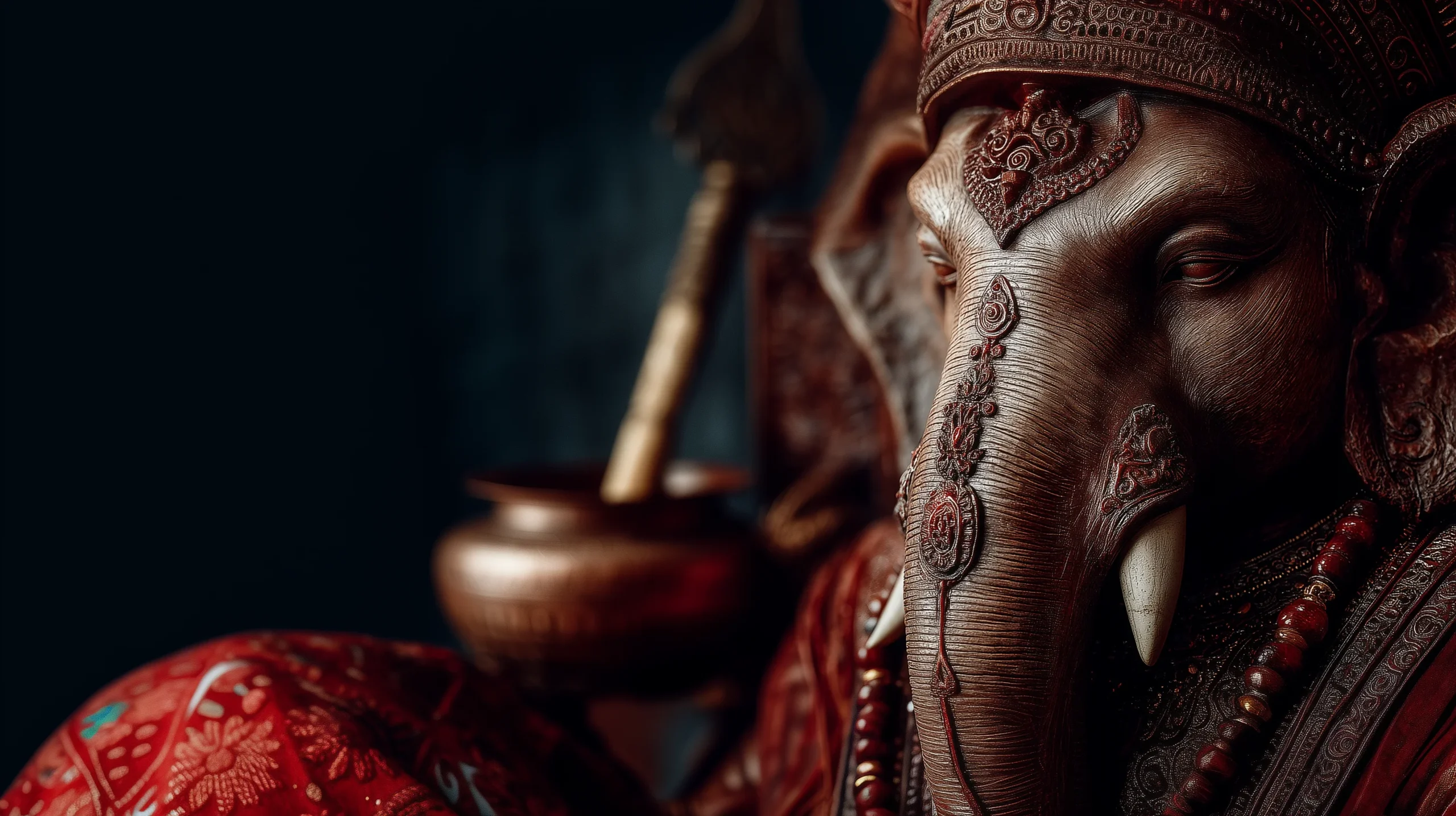
Ganpati.
Not the god on the poster. Not the statue in the window. Not the mantra they chant at the beginning of things as if beginnings were possible for people like you.
The boy.
The boy whose father did not recognize him. The boy who was doing what he was told — protect your mother, guard the door — and was destroyed for it. The boy who stood in the threshold doing the right thing and the right thing meant nothing because power does not care about right, power only cares about itself.
Shiva came home. Shiva wanted in. The boy said no — because his mother said no, because the door was his duty, because he did not know that the man demanding entry was the man who made him.
Shiva cut off his head.
The father unmade the child. The creator destroyed the created. The one who should have protected was the one who annihilated.
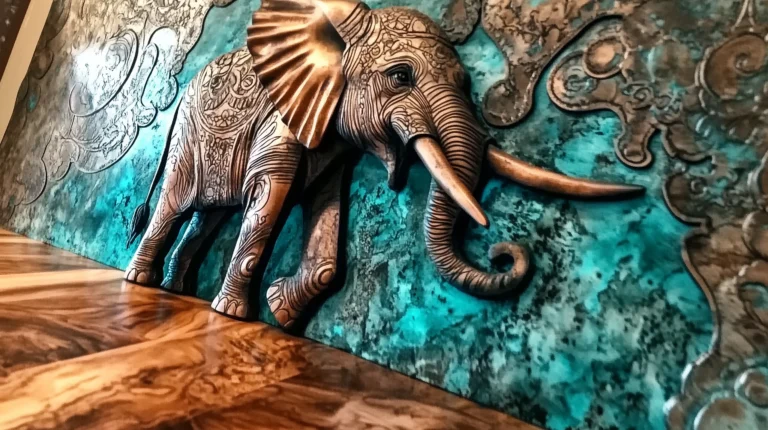
And then — only after the mother’s grief shook the three worlds, only after her scream made the universe tremble — then Shiva felt remorse. Then Shiva sent servants to find a replacement. Then Shiva grafted an elephant’s head onto his son’s body and said: rise.
As if rising undoes the cut. As if the new head erases the old one. As if the child who was whole before the blade is the same as the god who walks after it.
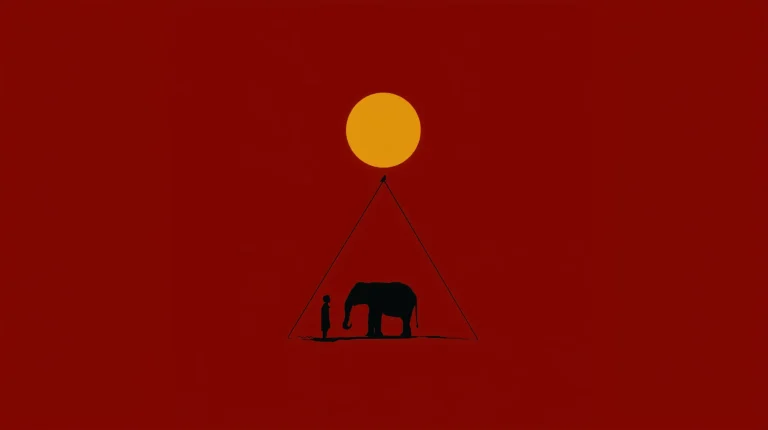
You are the boy at the door.
You were doing what you were supposed to do. Being small. Being quiet. Being good. Following the rules that someone else made, rules you didn’t understand, rules that were supposed to keep you safe.
And the blade came anyway.
And no one sent servants to find you a new head. No one’s grief shook the three worlds on your behalf. You just woke up the next morning in the same body in the same room with the same door that would open again, and again, and again.
You had to grow your own elephant head. You had to graft it yourself, in the dark, with no one watching, no god to breathe life back into what had been killed.
The head you wear now is not the head you were born with.
The head you were born with trusted. Expected love. Believed the world was safe and bodies were homes and the people who made you would protect what they made.
That head is gone. You don’t remember losing it. You only know it’s not there anymore — you reach for it sometimes, the way you reach for a word you’ve forgotten, the way you reach for a dream that dissolves when you try to hold it.
What grew in its place is something else. Something that scans every room for exits. Something that watches faces for the microexpression that means danger. Something that can smell a lie before it’s spoken, that can feel a hand about to strike before it moves.
You call it anxiety. You call it hypervigilance. You call it the thing that is wrong with you.
It is not wrong. It is the head that grew to survive what the first head couldn’t.
The tusk is broken.
Ganpati broke his own tusk to write the Mahabharata. This is what they tell you. He used his own body as an instrument. He turned his wholeness into a tool for creation.
But you know what it really means. You know because you have broken your own tusks. You have given pieces of yourself away — to lovers who needed you to be smaller, to bosses who needed you to be silent, to a world that required your sharp edges to be filed down so you wouldn’t cut anyone, so you wouldn’t cause problems, so you wouldn’t be the difficult one, the angry one, the one who couldn’t just get over it.
Your tusks are all over the floor of your life. Pieces of what you could have been, given away, broken off, sacrificed so that you could fit through doors that were never built for someone your size.
There is no healing that gives you back what was taken.
This is the truth they don’t print on the brochure. The therapy — if you could afford it — will not make you the child you were before the door opened. The medication — if you could afford it — will not undo the wiring that was installed in that room. The years of work, the decades of trying, the money you don’t have spent on techniques that sometimes help and sometimes don’t — none of it returns you to the before.
There is no before.
There is only after. There is only the elephant-headed thing you have become, walking through a world that doesn’t see the seam where the old head was removed, that doesn’t notice the weight of the new one, that wonders why you are so sensitive, so difficult, so unable to just relax.
The present moment.
They want you to live there. They say it like it’s an address you can move to, a place you can afford, a room where the door doesn’t open with that particular creak.
But the present moment contains all the moments. That is what they don’t understand. The present moment is not empty — it is full. It is full of every door that ever opened. Every hand that ever reached. Every night the ceiling became your only friend.
The present moment is not an escape from the past. The present moment is where the past lives, breathes, waits.
And still.
And still you are here.
Not healed. Healing is a word for people who had less to heal from. Healing is a destination for people whose journey was shorter.
You are not healed. You are something else. Something that doesn’t have a name in the language they taught you.
You are alive in a body that learned death before it learned its own name. You are present — not in the yoga way, not in the meditation app way — present in the way that a soldier is present, in the way that an animal in a forest is present, aware of every sound, every shift, every possible danger.
This is not a disorder. This is what survival looks like in a body that was never given the luxury of safety.
Ganpati sits at the threshold.
Not to bless you. Not to remove your obstacles. Not to grant you wishes like a god in a story for children.
He sits there because he knows. Because his father’s blade opened him too. Because his head is also grafted, also strange, also the evidence of something that should not have happened but did.
He is not there to save you.
He is there to be seen by you. To be recognized.
One broken thing seeing another.
The door still opens. In your dreams. In your body. In the moments when you think you are finally safe and then a sound, a smell, a shadow in the corner of your eye, and you are seven again, you are on the bed again, you are leaving for the ceiling again.
The door will always open. That is the truth they don’t tell you. The door is part of you now. The room is part of you. The body on the bed and the body on the ceiling — both of them are you, will always be you.
You are not trying to close the door. You cannot close the door.
You are learning to live in a house where one room is always that room.
This is not defeat. This is not despair.
This is the shape your survival took. This is the elephant head you grew in the dark. This is the broken tusk you used to write your own scripture — the one no one will read, the one written in sleepless nights and clenched jaws and the particular way you hold your breath when someone you love reaches for you.
You are the text and the author. The wound and the wounded. The child who was unmade and the god who walks anyway.
You cannot afford the therapy. The bread costs what the bread costs. The room takes what the room takes. The world eats what it eats, and it has been eating you since before you had words.
But you are not eaten yet. You are still here — elephant-headed, broken-tusked, scanning the room for exits, breathing small breaths, alive.
Alive is not nothing.
Alive, after what you survived, is everything.
Go gently, you who were not given gentleness.
Go slowly, you who were never allowed to rest.
Go on, you who were told you would not make it, could not make it, should not have made it.
You made it.
You are making it.
That is not healing. That is something harder than healing.
That is the thing that has no name.
That is you.
END TRANSMISSION