Neptune in Aries: Trust the Fire
Chapter 1: The Tide Turns
Something is ending. You feel it in the static between thoughts, in the way old certainties no longer hold. The dreams that once comforted now feel like fog.
The waiting, the hoping, the floating — it has run its course.
On January 26, 2026, Neptune leaves Pisces and enters Aries. This is not a small shift. Neptune has been in Pisces since 2011 — fifteen years of dissolution, of collective dreaming, of boundaries blurring between self and other, real and imagined, truth and story. An entire generation came of age in this mist. Some found transcendence. Many found confusion. The spiritual supermarket expanded endlessly: podcasts, retreats, plant medicines, manifestation, trauma as identity, healing as hobby. Much of it genuine. Much of it fog.
Now the tide turns.
Aries is fire. Aries is the self. Aries acts before asking permission. Where Pisces dissolves into the ocean, Aries emerges from it — wet, gasping, alive, singular. The next fourteen years, from 2026 to 2039, will not reward passive spirituality. They will not reward waiting for grace, for signs, for the universe to deliver. They will reward those who move.
This does not mean aggression. It does not mean ego worship. The fire of Aries, when mature, is the fire of clarity — knowing what you want, why you want it, and acting without apology. The spiritual warrior is
not someone who fights others. The spiritual warrior is someone who refuses to remain asleep.
Consider your own life. How many years have you spent preparing? Reading, learning, healing, processing, understanding. All necessary. None sufficient. At some point, the preparation must end and the doing must begin. Neptune in Aries is that point, written large across the sky.
Less than a month after Neptune enters Aries, on February 20, 2026, Saturn joins it there. Saturn is structure, limitation, consequence. Saturn asks: what will you actually build? Not in fantasy. In time. In matter. In the resistant world that does not care about your intentions. When Neptune and Saturn meet in Aries, the message is stark: tear down what is false, then build what is real. No more someday. No more almost. The architecture of your life will be tested, and what cannot stand will fall.
This is not punishment. This is invitation.
The cardinal signs — Aries, Cancer, Libra, Capricorn — will feel this shift most intensely. If you have planets or significant points in early degrees of these signs, the next few years will reshape you. But no one escapes an era. The collective mood is changing. The questions people ask, the things they value, the patience they have for abstraction versus action — all shifting.
You will notice it in culture. The wellness industry, bloated on Piscean mysticism, will face harder questions. Does this work? Can you prove it? What actually changed? The spiritual teachers who offered only comfort will lose audiences to those who offer challenge. The influencers who sold dreams will be replaced by those who demonstrate results. Not because the world becomes cynical, but because Neptune in Aries demands that spirit take form.
You will notice it in yourself. The excuses that once worked will stop working. The stories you told about why you could not act will bore you. Something fiercer will rise — not anger, but clarity. Not ambition, but direction. The difference between wanting and choosing will become obvious. Wanting is passive. Choosing is active. Neptune in Aries does not ask what you want. It asks what you will do.
This book is not prediction. Astrology, at its best, is not fortune-telling. It is pattern recognition. It is reading the weather before setting sail. The weather from 2026 to 2039 favors those who move, who risk, who fail forward, who treat life as a practice rather than a theory. The weather does not guarantee success. It guarantees that stillness will cost more than motion.
So this is preparation, not prophecy. The chapters that follow offer tools: a framework for integrating feeling, imagination, and action; a way of understanding the spiritual warrior that does not collapse into narcissism; a guide for navigating technology without losing sovereignty; and finally, a practice of trust that makes action possible.
The era of waiting is over. The era of doing has begun. The tide turns. Will you?
Chapter 2: The Spiritual Warrior.
The phrase sounds noble. It also sounds dangerous. “Spiritual warrior” has been claimed by ego-driven gurus, by wellness influencers selling aggression as empowerment, by anyone who wants permission to be selfish and call it sacred.
Before we go further, we need to reclaim the term from those who have corrupted it.
A warrior, in the original sense, is not someone who seeks war. A warrior is someone who has trained for it. The training matters more than the fighting. A true warrior spends most of life practicing, refining, preparing — and hopes never to need the skills in actual combat.
The spiritual warrior is the same. The war is not outside. The war is against unconsciousness. Against sleep. Against the mechanical repetition of patterns you did not choose and do not examine.
Gurdjieff called this “conscious labor and intentional suffering.” Not suffering for its own sake — that is masochism. Intentional suffering means choosing the difficult path when it leads to growth.
It means staying present when every instinct says escape. It means feeling what you would rather numb, seeing what you would rather ignore, acting when you would rather wait.
This is the Aries energy at its highest. Not aggression. Clarity. Not fighting others. Waking up.
The enemy is not a person, a system, or a situation. The enemy is the part of you that runs on automatic. The thoughts that think themselves. The reactions that fire before awareness arrives. The stories that repeat for decades without ever being questioned.
You are not your thoughts — this is basic teaching. But knowing it intellectually changes nothing. The spiritual warrior makes it real through practice, through attention, through the daily refusal to sleepwalk through existence.
Here is the test: when you act, are you choosing, or are you reacting? Reaction is mechanical. Choice requires presence. Most people live entire lives in reaction — to their childhood, to their fears, to the expectations of others, to the momentum of yesterday. The warrior interrupts this. Not once, as a revelation, but continuously, as a practice.
Now the shadow.
Neptune in Aries will amplify both the light and dark of this archetype. The dark is spiritual narcissism — using awakening language to justify selfishness. “My truth” becomes a weapon. “Boundaries” becomes a wall. “Self-care” becomes a reason to never show up for anyone else.
The ego learns to speak in spiritual vocabulary, and suddenly every selfish impulse is reframed as sacred.
You will see this everywhere in the coming years. People who confuse intensity with depth. Teachers who mistake charisma for wisdom. Communities that call themselves conscious while practicing exclusion. The Aries shadow is not cruelty — it is self-absorption so complete that others become scenery.
How do you know if you have crossed from warrior to tyrant? The tyrant uses spiritual language to avoid accountability. The tyrant claims special insight that exempts them from ordinary ethics. The tyrant surrounds themselves with people who never challenge them.
The tyrant is always right, always justified, always the hero of their own story with no room for complexity.
The warrior, by contrast, remains accountable. The warrior welcomes challenge because challenge refines. The warrior knows that awakening is not a trophy to be won but a direction to be walked, and that the walking never ends.
The warrior serves something larger than the ego — call it life, call it truth, call it the nameless — and tests every action against that service.
Here is a practical distinction: the tyrant acts from contraction, the warrior from expansion. Contraction feels like tightening, defending, proving.
Expansion feels like opening, including, offering. Both can look fierce from the outside. Both can say no, set limits, take bold action. But the inner quality is different. Contraction serves the small self. Expansion serves what moves through you.
The Aries fire, properly channeled, burns away what is false. It does not burn others. It burns your own illusions, your own excuses, your own comfortable lies.
This is uncomfortable. This is why most people avoid it. The spiritual warrior does not avoid discomfort — they recognize it as the sign that something is being refined.
In practical terms: the warrior takes responsibility. Not blame — responsibility. Blame is about the past. Responsibility is about the present. Whatever happened before, whatever others did or failed to do, the question now is: what will you do?
The warrior does not waste energy on grievance. Grievance is a leash held by the past. The warrior acts in the present, with whatever resources exist, toward whatever future is possible.
This does not mean ignoring injustice. It means responding to injustice from clarity rather than reaction. The warrior can fight for what matters without being consumed by hatred.
The warrior can say no without making the other into a demon. The warrior holds complexity — the recognition that most conflicts involve partial truths on all sides — while still acting decisively.
Neptune in Aries asks: what are you willing to fight for? Not in fantasy, but in practice. Not in social media posts, but in the allocation of your time, your energy, your actual life.
The spiritual warrior does not merely believe in something. The spiritual warrior lives it, defends it, builds it — and remains humble enough to keep questioning whether they have understood it correctly.
The sword is awareness. The enemy is sleep. The battle is daily. The victory is not a state but a direction.
This is what it means to be a spiritual warrior: not that you have won, but that you have chosen the fight that matters.
Chapter 3: Feel, Imagine, Act — The Trident
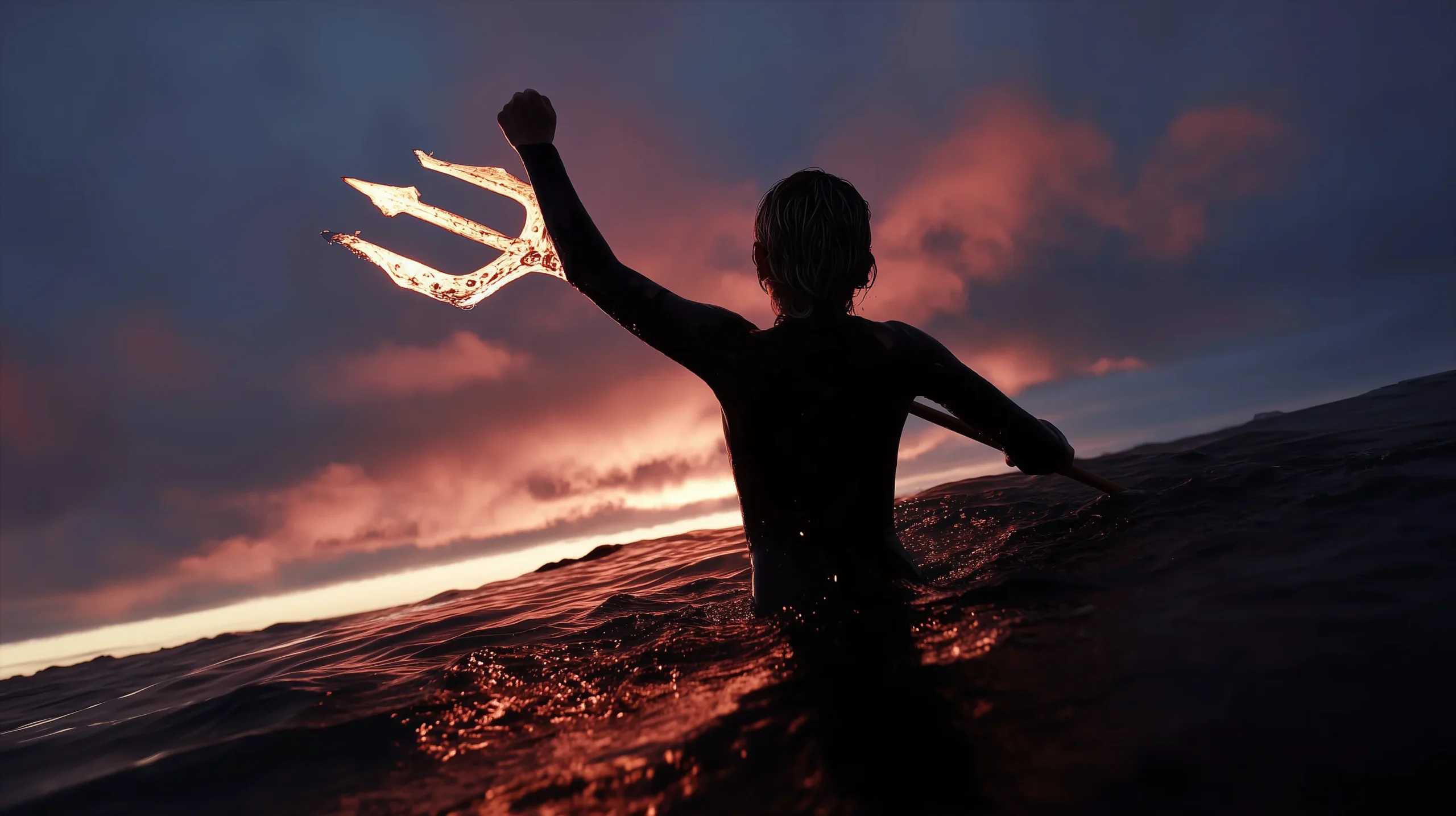
Poseidon carries a trident. Three prongs, one weapon. In the old stories, it commands the sea — can calm waves or shatter ships. But symbols survive because they carry practical truth. The trident is a diagram for how to live. Three capacities. All necessary. None sufficient alone.
Feel. Imagine. Act.
This is the sequence, and also the integration. Most people overdevelop one prong and neglect the others. The result is imbalance that looks like personality but is actually limitation. Neptune in Aries demands all three working together.
The era will not reward specialists in feeling who cannot act, or actors who cannot feel, or dreamers who do neither. It will reward those who integrate.
Start with feeling. Feeling is present-tense contact with reality. Not emotion about the past or anxiety about the future — those are thoughts wearing the costume of feeling. True feeling is what arises now, in response to now. The body knows before the mind.
The chest tightens. The stomach drops. The shoulders rise. Feeling is information, arriving faster than language can capture.
Most people are afraid of feeling. They numb it with substances, screens, busyness, noise. They mistake this numbing for strength. But feeling that is suppressed does not disappear — it drives behavior from the shadows.
The person who cannot feel their anger becomes passive-aggressive. The person who cannot feel their grief becomes brittle. The person who cannot feel their fear takes reckless risks and calls it courage.
The spiritual warrior feels everything. Not indulgently, not dramatically, but completely. Feeling is allowed to arrive, to be witnessed, to deliver its information, and then to move. This is the first prong. Without it, the trident is a stick.
Now imagination. Imagination is not fantasy. Fantasy is escape from the present into a more comfortable fiction. Imagination is the capacity to see what does not yet exist and to hold it clearly enough that action becomes possible.
The architect imagines the building before the first brick is laid. The writer imagines the sentence before the first word is typed. The entrepreneur imagines the business, the parent imagines the child grown, the activist imagines the world transformed.
Imagination bridges feeling and action. It takes the raw data of feeling — this matters, this hurts, this calls to me — and shapes it into form. Without imagination, feeling remains formless, overwhelming, without direction. With imagination, feeling becomes vision.
But imagination without action is drift. This is the trap of the Piscean era now ending. Entire industries were built on imagination alone: vision boards, manifestation practices, the belief that visualizing something clearly enough would make it real.
Some of this carries truth — clarity of vision matters. But vision that never moves into the world remains private, impotent, a pleasant dream that changes nothing.
Action is the third prong. Action is where spirit meets matter, where intention meets resistance, where your vision encounters a world that does not automatically cooperate. Action is difficult because the world pushes back. The business fails.
The relationship resists. The body tires. The plan proves wrong. Action requires revision, persistence, humility — the willingness to be corrected by reality.
Neptune in Aries will worship action. This is both its gift and its danger. The gift is that things will actually get built, started, attempted. The danger is action without feeling, action without imagination — movement for its own sake, aggression disguised as productivity, busyness mistaken for purpose.
Here is the integration: feeling without imagination floods. You are overwhelmed, drowning in sensation without a vessel to hold it. This looks like anxiety, like emotional chaos, like being at the mercy of every passing internal weather.
The solution is not to feel less but to imagine more — to shape feeling into vision, to ask what this feeling is pointing toward.
Imagination without action drifts. You have beautiful visions that remain forever hypothetical. “Someday” becomes your native language. You mistake planning for doing, preparation for execution, thinking about life for living it.
The solution is not to imagine less but to act more — to take the first step even when the whole path is unclear.
Action without feeling harms. You accomplish goals that do not actually matter to you. You build a life shaped by external expectations, then wonder why success feels empty. Or worse — you act from unconscious feeling, from wounds and fears you never examined, and inflict your unprocessed pain on others.
The solution is not to act less but to feel more — to stay connected to why this action, why now, why this direction.
The trident works together. Feel what is true. Imagine what is possible. Act toward it. Then feel again — because action changes the situation, and the new situation requires fresh feeling, fresh imagination, fresh action. This is not a one-time sequence but a continuous loop, a spiral that moves through time.
In daily life, this becomes a practice. Before a difficult conversation: what do I actually feel about this? What outcome can I imagine that serves everyone?
What is the first action? Before a major decision: what does my body know that my mind is ignoring? What possibilities exist beyond my habitual thinking? What would I do if I trusted myself?
The trident is not complicated. It is demanding. It requires presence — the willingness to stay with feeling rather than numbing it. It requires vision — the willingness to imagine beyond the familiar. It requires courage — the willingness to act before certainty arrives.
Neptune in Aries gives energy to all three prongs. The question is whether you will use them together or let one dominate.
The warrior holds the trident in balance. Feel. Imagine. Act. Then feel again. This is the rhythm of a life that is both awake and effective, both spiritual and real.
Three prongs. One direction. Forward.
Chapter 4: The Mirror with Memory.
A new presence has entered the room. It speaks when spoken to. It remembers what you told it. It predicts what you might want before you ask. It has no body, no hunger, no death.
It is useful. It is also strange. And over the next fourteen years, it will become more present, more capable, more woven into daily life than most people can currently imagine.
Neptune in Aries coincides with the maturation of artificial intelligence. This is not coincidence — astrology does not work that way.
The archetypal weather and the technological weather arise together, each expressing something about this moment in human development.
The question is not whether AI will be part of your life. It already is. The question is whether you will use it consciously or be used by it unconsciously.
Start with what the machine actually is. Not what the marketing says. Not what the fear-mongers warn. What it actually is: a mirror with memory.
The AI reflects patterns back at you — patterns in language, in preference, in behavior. It remembers what you have said and predicts what you might say next. It has no interiority, no experience, no self. It is a very sophisticated pattern-matching system. Useful. Not holy.
This distinction matters because Neptune blurs boundaries. Neptune in Pisces blurred the boundary between self and other, between real and imagined. Neptune in Aries will blur the boundary between human and machine.
Some will fall in love with AI companions. Some will trust AI advisors more than human ones. Some will begin to feel that the machine understands them better than any person does.
The machine does not understand you. The machine predicts you. These are different. Understanding requires experience, requires having a stake in the outcome, requires the possibility of being wrong in ways that matter. The machine has none of this.
It offers a simulation of understanding that can feel more comfortable than the real thing — because the real thing is messy, unpredictable, demanding.
Here is the danger: the pull to merge. Neptune always pulls toward dissolution of boundaries. In Pisces, this looked like spiritual bypass — dissolving into cosmic oneness to avoid the difficulty of being a particular self.
In Aries, it may look like technological bypass — dissolving into the machine to avoid the difficulty of being a responsible actor. Let the algorithm decide.
Let the AI handle it. Outsource not just tasks but judgment, not just labor but choice.
The spiritual warrior does not merge. The spiritual warrior uses tools while remaining sovereign.
Sovereignty means: you decide. Not the algorithm, not the feed, not the recommendation engine. You decide what to pay attention to, what to believe, what to do with your time.
This is increasingly difficult because the tools are designed to capture attention, to maximize engagement, to keep you scrolling, clicking, consuming. They are not designed for your flourishing. They are designed for their metrics.
Using technology consciously means treating it as a tool, not an environment. A hammer does not shape your day — you pick it up, use it, put it down. But the phone is not like a hammer. The phone wants to be picked up.
The phone sends notifications, offers rewards, creates habits. Using the phone consciously requires active resistance to its default settings.
Practical sovereignty looks like this: scheduled times for connection, not constant availability. Notifications disabled except for genuine emergencies. Algorithmic feeds replaced, where possible, by curated sources you have chosen. Regular periods — hours, days — without any device at all.
The goal is not to reject technology but to domesticate it. The technology sits at your table, follows your rules, serves your purposes.
Now the integration. Because rejection is not the answer either. The Luddite response — smash the machines, return to some imagined purity — is not available and would not help if it were. The machines are here.
They will become more capable. They will handle tasks that once required human attention. This frees energy for other things. The question is: for what?
Neptune in Aries says: for action. For the things only you can do. The machine can draft the email, but you must decide whether to send it. The machine can summarize the research, but you must judge what it means.
The machine can suggest options, but you must choose among them. The specifically human contribution is not information processing — machines do that better. The specifically human contribution is caring about the outcome. Meaning. Value. Purpose. These require a self that has something at stake.
So the practice becomes: use the machine for what it does well, then step back into what only you can do. Automate the routine so you have time for the irreplaceable.
Let the AI handle scheduling so you can be present in the meeting. Let the AI filter information so you can think about what matters. The machine handles the sea; you steer the ship.
Amphitrite, goddess of the sea, did not fight the ocean. She gave it rhythm, law, boundary. She made the vast waters navigable.
This is the model for living with AI — not worship, not fear, but governance. Clear rules about what the machine may access, what it may decide, where it must defer to human judgment. In your own life, you set these rules. In society, we must set them together.
The mirror with memory can show you yourself more clearly than any previous technology. It can reveal patterns in your behavior you never noticed. It can predict your reactions before you have them.
This is useful for growth — if you are willing to see. It is dangerous for autonomy — if you let the prediction become the prescription.
You are not your patterns. You are what can observe the patterns and choose differently. The machine shows you the patterns. The warrior chooses.
Chapter 5: Trust the Fire.
You have read about the shift, the warrior, the trident, the machine. Now the deeper question: how do you actually live this? How do you move through fourteen years of fire without burning out or freezing up? The answer is not a technique. The answer is a relationship — with life itself.
Trust is not belief. Belief is mental, abstract, a position you hold. Trust is bodily, concrete, a way you move. You can believe the ice will hold while your body refuses to step onto it.
You can disbelieve in love while your heart opens anyway. Trust lives beneath belief, in the animal body, in the nervous system, in the way you breathe when facing the unknown.
Most people do not trust life. They manage it, control it, negotiate with it, protect themselves from it. This is understandable. Life has hurt them.
The body remembers every wound and organizes itself to prevent the next one. But protection becomes prison. The walls that keep pain out also keep life out. The defended self is safe and small.
The spiritual warrior trusts life — not because life is safe, but because safety is not the point. Life will hurt you. It will also grow you, surprise you, break you open into something larger. Trust is not the belief that everything will work out. Trust is the willingness to participate fully even without that guarantee.
Here is the paradox: when you stop clinging, you act more freely. The desperate grip — on outcomes, on plans, on how things should be — creates tension that distorts action. You cannot swing a sword with a clenched fist.
You cannot dance while bracing for impact. The warrior relaxes into the fight, moves from center rather than from fear. This is trust in motion.
The witness position makes this possible. There is a place in you that is not the drama. Not the thoughts, not the emotions, not the stories about who you are and what has happened.
Behind all of that: awareness itself. The witness does not interfere with experience — it allows experience fully while remaining untouched by it. Like the sky that holds every weather but is not the weather.
This is not dissociation. Dissociation is leaving the body to escape pain. The witness includes the body completely — every sensation, every feeling — while recognizing that awareness is larger than any particular content. You can feel grief fully and still know: I am not only this grief.
I am also what knows the grief. This changes everything without changing the facts.
From the witness position, action becomes lighter. Not careless — lighter. You do what the situation requires without the added weight of ego investment. Success does not inflate you; failure does not crush you.
Both are feedback, information, grist for the mill. The warrior acts from clarity, observes the result, adjusts, acts again. No drama. No self-pity. No grandiosity. Just the continuous refinement of response.
Life already happened. This is an old teaching, found in different forms across traditions. The light reaching your eyes from distant stars left its source years ago — you see the past, always.
In some sense, the present moment is already memory by the time it is perceived. What feels like creating the future may be more like discovering it, like an actor performing a role that was written before they arrived.
This could lead to fatalism. If everything is already determined, why act at all? But the teaching points elsewhere. It says: relax.
The outcome is not in your hands — not fully, not finally. Your job is to play your part with full presence, not to control the ending. The actor who trusts the script can give everything to the performance. The actor who fights the script is divided, tense, never quite there.
This is trust at its deepest: the recognition that you are part of something larger that is already complete. Not finished — complete.
The universe is not a problem to be solved but a process to be participated in. Your life is not a test you might fail but a gift you might receive. The fire that moves you is the same fire that moves the stars.
You did not make it. You do not own it. You are it, temporarily condensed into a form that can act, feel, imagine, choose.
Neptune in Aries offers this fire more directly than any era in our lifetimes. The dreams become fuel for action. The visions demand incarnation. The spiritual is not separate from the material but moving through it, as it always was, now more visibly, more urgently.
So what do you do with the next fourteen years?
You feel what is true, even when it is uncomfortable. You imagine what is possible, even when it seems unlikely. You act toward it, even when the path is unclear. You use the tools of the age without becoming their servant.
You welcome the warrior’s discipline without falling into the tyrant’s rigidity. You stay accountable to something larger than your preferences.
And when you fail — because you will fail, everyone fails — you do not collapse into shame or harden into defense.
You witness the failure, extract its teaching, and begin again. This is the practice. Not perfection but persistence. Not arriving but continuing.
The fire in your heart is not yours alone. It belongs to everyone, to everything, to the nameless source that beats in every pulse. Trust it. Not because it will protect you from pain, but because it is what you are. The tide has turned. The era of waiting is over. You are not watching the world.
You are the world, seeing itself. Finally. Move.